
California, the most populous state in the United States, maintains one of the most detailed and transparent crime data systems in the nation. Crime statistics in the state are collected, analyzed, and published by the California Department of Justice (DOJ), specifically through its Criminal Justice Statistics Center (CJSC). These statistics cover a wide range of offenses, including violent crimes such as homicide, assault, and rape, as well as property crimes like burglary, motor vehicle theft, and arson. The data is gathered from law enforcement agencies across all 58 counties and standardized using FBI Uniform Crime Reporting (UCR) guidelines. This allows for consistent year-over-year comparisons and national benchmarking. The primary source for annual crime trends is the “Crime in California” report, which provides rates per 100,000 residents to account for population changes.
Since the early 1990s, California has experienced a significant decline in overall crime rates. After a peak in the early 1990s, both violent and property crime rates have steadily decreased. For example, between 2009 and 2010, violent crime dropped by 6.9%, marking the lowest rate since 1968. Property crime fell by 2.7% in the same period, with motor vehicle theft showing the steepest decline—down 7.6% annually and 62% since its 1989 peak. Arson rates dropped 38.9% from 2005 to 2010. These trends reflect broader national patterns but are particularly notable given California’s large and diverse population. The state’s crime data also reveals demographic disparities: young men face the highest victimization risk, and Black residents are 30% more likely to be crime victims than white residents. In 75% of violent crimes, victims and offenders share the same race.
Official Crime Data Sources in California
The California Department of Justice serves as the central hub for all official crime statistics in the state. Through its Criminal Justice Statistics Center, the DOJ publishes annual reports, databases, and interactive tools that allow researchers, policymakers, and the public to examine crime trends. These resources are built on data submitted by local law enforcement agencies and follow strict federal reporting standards. The CJSC maintains 16 distinct databases, including records on arrests, homicides, hate crimes, and juvenile justice. All data is publicly accessible and updated regularly to ensure transparency and accountability in law enforcement practices.
California Department of Justice Criminal Justice Statistics Center
The CJSC is responsible for collecting, analyzing, and distributing crime data across California. It operates under the authority of the Attorney General and collaborates with over 800 law enforcement agencies. The center ensures data accuracy by validating submissions and aligning them with FBI UCR protocols. Its flagship publication, “Crime in California,” is released annually and includes detailed breakdowns of crime rates, arrest trends, and demographic patterns. The report is available in PDF format on the official website and serves as the primary reference for state-level crime analysis.
- Maintains 16 crime-related databases
- Publishes annual “Crime in California” report
- Validates data from 800+ law enforcement agencies
- Follows FBI Uniform Crime Reporting standards
FBI Uniform Crime Reporting Program and California
California participates fully in the FBI’s Uniform Crime Reporting (UCR) Program, which standardizes crime data collection across the U.S. This allows for direct comparisons between states and national averages. The UCR categorizes offenses into two main groups: Part I offenses (violent and property crimes) and Part II offenses (less serious crimes like fraud and drug violations). California’s data is submitted monthly by local agencies and aggregated at the state level. The FBI then publishes national summaries, including California-specific statistics, in its annual “Crime in the United States” report. This integration ensures California’s crime data meets federal quality benchmarks.
- Local agencies submit monthly crime reports to the DOJ
- DOJ validates and forwards data to the FBI
- FBI publishes national and state-level summaries annually
- Data used for federal funding, policy, and research
Accessing the “Crime in California” Annual Report
The most comprehensive source for crime statistics in California is the annual “Crime in California” report. This document provides a detailed analysis of crime trends, arrest rates, and victim demographics. To access the latest report, visit the official CJSC publications page. The report is typically released in the fall and covers data from the previous calendar year. It includes tables on homicide rates, robbery statistics, burglary trends, and motor vehicle theft. Each category is broken down by county, city, and demographic group. The report also compares California’s crime rates to national averages and highlights significant changes over time.
- Published annually by the California DOJ
- Available in PDF format on the official website
- Includes data from all 58 counties
- Compares state rates to national averages
Accessing California Crime Data and Public Safety Reports
California provides public access to crime statistics and law enforcement data through official state and federal agencies. These systems are primarily designed for research, policy analysis, and public transparency rather than individual name-based searches.
California DOJ Crime Statistics
The California Department of Justice publishes statewide crime data, including annual reports and statistical summaries.
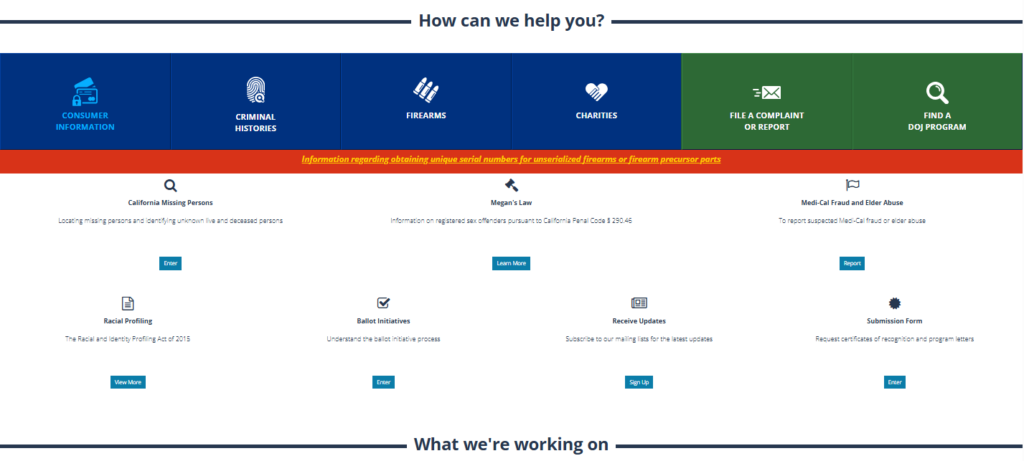
- From the official website, navigate to:
Criminal Justice Statistics Center (CJSC) → Publications & Data
Available Information Includes
- Statewide crime trends
- Violent and property crime statistics
- County-level crime summaries
- Arrest and clearance rate data
- Annual crime reports
FBI Crime Data
The FBI provides national and state-level crime statistics https://cde.ucr.cjis.gov/ through its official Crime Data Explorer.

Users can:
- Select California as the state
- Choose crime categories
- View historical trends
- Download statistical datasets
Data Includes
- Crime rates by category
- Agency-level reporting
- Yearly comparisons
- Population-adjusted statistics
Violent Crime Trends in California
Violent crime in California includes homicide, forcible rape, robbery, and aggravated assault. These offenses are closely monitored due to their severe impact on public safety. Over the past three decades, violent crime rates have declined significantly. From 2009 to 2010, the violent crime rate dropped by 6.9%, reaching its lowest level since 1968. This decline is part of a long-term trend that began after a peak in the early 1990s. Despite this progress, certain cities and demographic groups continue to experience higher rates of violent crime. The state’s data also shows that victims and offenders are often of the same race in the majority of violent incidents.
Homicide and Murder Rates
Homicide remains one of the most serious violent crimes tracked in California. The state’s homicide rate has fluctuated over the years but has generally trended downward since the 1990s. In 2010, the homicide rate was 5.3 per 100,000 residents, a decrease from previous years. Most homicides occur in urban areas, with Los Angeles, Oakland, and San Bernardino reporting the highest numbers. Firearms are used in approximately 70% of homicides. The California DOJ publishes a separate “Homicide in California” report that provides in-depth analysis of victim and offender profiles, weapon use, and clearance rates.
| Year | Homicide Rate (per 100,000) |
| 2005 | 6.1 |
| 2008 | 5.8 |
| 2009 | 5.7 |
| 2010 | 5.3 |
Robbery and Assault Statistics
Robbery and aggravated assault are two of the most common violent crimes in California. Robbery involves taking property through force or threat, while aggravated assault includes attacks with weapons or intent to cause serious harm. From 2009 to 2010, robbery rates decreased by 8.2%, and aggravated assault rates dropped by 5.1%. These declines contributed to the overall reduction in violent crime. Urban centers like Los Angeles and San Francisco report higher robbery rates, often linked to street crime and public transportation. Assaults are more evenly distributed but are more frequent in areas with higher population density.
- Robbery rate down 8.2% (2009–2010)
- Aggravated assault rate down 5.1% (2009–2010)
- The highest robbery rates in Los Angeles and San Francisco
- Assaults more common in densely populated areas
Forcible Rape and Sexual Assault Data
Forcible rape is a serious violent crime that remains underreported in California and nationwide. The state’s data shows a decline in reported rape cases, with a 4.3% drop between 2009 and 2010. However, experts believe actual rates are higher due to underreporting. The California DOJ tracks both forcible rape and other sexual assaults, including those against minors. The “Crime in California” report includes breakdowns by age, gender, and location. Most incidents occur in residential settings, and offenders are often known to the victim. The state has implemented specialized units and reporting systems to improve data collection and victim support.
- Reported forcible rape down 4.3% (2009–2010)
- Underreporting remains a significant challenge
- Most incidents occur in homes
- Offenders often known to victims
Property Crime Trends in California
Property crime includes burglary, larceny-theft, motor vehicle theft, and arson. These offenses are more common than violent crimes but generally less severe in terms of physical harm. California has seen a consistent decline in property crime since the 1980s. From 2009 to 2010, the overall property crime rate dropped by 2.7%. Motor vehicle theft showed the most significant improvement, falling by 7.6% annually and 62% since 1989. Arson rates also declined sharply, down 38.9% from 2005 to 2010. These trends reflect improved law enforcement strategies, better security technology, and economic factors.
Burglary and Home Break-Ins
Burglary involves unlawful entry into a structure with the intent to commit theft or another crime. In California, residential burglary is more common than commercial burglary. The burglary rate decreased by 3.1% between 2009 and 2010. Most break-ins occur during daytime hours when homes are unoccupied. Common targets include electronics, jewelry, and cash. Urban and suburban areas report higher burglary rates, particularly in cities like Sacramento and Fresno. The state tracks both forcible entry and unlawful entry without force, with the latter being more frequent.
| Year | Burglary Rate (per 100,000) |
| 2005 | 678 |
| 2008 | 642 |
| 2009 | 621 |
| 2010 | 601 |
Motor Vehicle Theft Statistics
Motor vehicle theft has been a major focus of California law enforcement due to its high frequency and economic impact. The state once had one of the highest vehicle theft rates in the nation, peaking in 1989. Since then, thefts have declined by 62%. From 2009 to 2010 alone, thefts dropped by 7.6%. This improvement is attributed to anti-theft devices, license plate recognition systems, and task forces targeting organized theft rings. Cities like Los Angeles, Oakland, and San Jose still report elevated theft rates, but overall trends are positive. The DOJ tracks thefts by vehicle type, with older models being more vulnerable.
- 62% decline in motor vehicle theft since 1989
- 7.6% drop from 2009 to 2010
- Los Angeles and Oakland are among the highest-risk cities
- Older vehicles are more frequently targeted
Larceny-Theft and Arson Rates
Larceny-theft, or theft of property without force, is the most common property crime in California. It includes shoplifting, pickpocketing, and bicycle theft. The larceny rate decreased by 2.1% between 2009 and 2010. Arson, the intentional burning of property, also declined significantly—down 38.9% from 2005 to 2010. Most arsons are committed for insurance fraud or vandalism. The state tracks both structural and vehicle arson, with residential fires being the most common. Law enforcement uses fire investigation units and data sharing to identify patterns and suspects.
- Larceny-theft down 2.1% (2009–2010)
- Arson down 38.9% (2005–2010)
- Most arsons involve residential properties
- Insurance fraud a common motive
Crime Rates by City and County
Crime rates vary significantly across California’s 58 counties and hundreds of cities. Urban areas like Los Angeles, San Francisco, and Oakland typically report higher crime rates due to population density and socioeconomic factors. Rural counties such as Alpine and Sierra have very low crime rates but may face challenges in law enforcement coverage. The California DOJ provides county-level data in its annual reports, allowing for detailed comparisons. Cities are ranked by crime rate per 100,000 residents to ensure fair comparisons regardless of population size.
Los Angeles County Crime Data
Los Angeles County is the most populous county in California and one of the largest in the U.S. It consistently reports high numbers of both violent and property crimes due to its size. However, crime rates have declined over time. In 2010, the county recorded a violent crime rate of 485 per 100,000 and a property crime rate of 2,100 per 100,000. Homicide and robbery are more common in South Los Angeles and the San Fernando Valley. The Los Angeles Police Department (LAPD), the Los Angeles County Sheriff’s Department, and the Los Angeles clerk’s office submit detailed monthly reports to the state. These are used to track trends and allocate resources.
- Violent crime rate: 485 per 100,000 (2010)
- Property crime rate: 2,100 per 100,000 (2010)
- Highest homicide rates in South LAThe
- LAPD and the Sheriff’s Department report monthly
San Francisco and Bay Area Crime Trends
San Francisco reports higher property crime rates than the state average, particularly in larceny and motor vehicle theft. In 2010, the city had a property crime rate of 3,200 per 100,000, one of the highest in the state. Violent crime is lower but still present, with robbery being the most common violent offense. The Bay Area, including Oakland and San Jose, faces challenges with gang-related violence and drug crimes. The California DOJ tracks regional trends and publishes comparative data for the nine-county Bay Area. Law enforcement agencies use this data to coordinate anti-crime initiatives.
- San Francisco property crime rate: 3,200 per 100,000 (2010)
- Robbery most common violent crime
- Oakland reports high homicide rates
- Regional data published for the Bay Area
Sacramento and San Diego Crime Comparisons
Sacramento and San Diego represent two distinct urban environments in California. Sacramento, the state capital, has a moderate crime rate with higher-than-average burglary and assault rates. San Diego, a coastal city, reports lower overall crime but faces challenges with drug-related offenses and border-related smuggling. In 2010, Sacramento’s violent crime rate was 520 per 100,000, while San Diego’s was 380. Both cities have seen declines in crime over the past decade. The DOJ provides city-specific reports that include arrest data, clearance rates, and demographic breakdowns.
| City | Violent Crime Rate (2010) | Property Crime Rate (2010) |
| Sacramento | 520 | 2,400 |
| San Diego | 380 | 1,900 |
Demographic Patterns in California Crime
Crime in California is not evenly distributed across demographic groups. Data shows that young men, particularly those aged 18 to 24, are the most likely to be both victims and perpetrators of crime. Black residents face a 30% higher risk of victimization compared to white residents. In 75% of violent crimes, the victim and offender are of the same race. Teenagers are especially vulnerable to personal theft and assault. These patterns are consistent across multiple years and are analyzed in the “Crime in California” report to inform public safety policies.
Age and Gender Disparities
Age and gender play significant roles in crime victimization and offending. Males are more likely than females to be involved in crime, both as victims and offenders. Young men aged 18 to 24 have the highest arrest rates for violent and property crimes. Teenagers are frequently victims of robbery and assault, often in school or public settings. Women are more likely to be victims of sexual assault and domestic violence. The state tracks these trends to develop targeted prevention programs, such as youth outreach and domestic violence shelters.
- Males more likely to be crime victims and offenders
- Young men (18–24) have the highest arrest rates
- Teenagers vulnerable to robbery and assault
- Women are at higher risk of sexual assault
Racial and Ethnic Crime Data
Racial disparities in crime are evident in California’s data. Black residents are 30% more likely to be crime victims than white residents. Hispanic and Latino communities also report higher victimization rates in certain categories. In 75% of violent crimes, the victim and offender share the same race. This pattern is consistent across homicide, assault, and robbery. The state does not collect race data for all offenses but includes it in major crime reports. These statistics are used to address systemic issues and improve community policing.
- Black residents 30% more likely to be victims
- 75% of violent crimes involve the same-race victim/offender
- Hispanic communities face elevated robbery rates
- Data used to improve community policing
Juvenile Crime and Arrest Trends
Juvenile crime in California has declined over the past two decades. The total juvenile arrest rate dropped by 6% from 2009 to 2010. Most juvenile offenses are property-related, such as theft and vandalism. Violent crime among youth is less common but still tracked closely. The state publishes a “Juvenile Justice in California” report that includes data on arrests, detentions, and rehabilitation programs. Schools and law enforcement collaborate on prevention efforts, including truancy reduction and after-school programs.
| Year | Juvenile Arrest Rate (per 100,000) |
| 2005 | 1,200 |
| 2008 | 1,050 |
| 2009 | 980 |
| 2010 | 920 |
Crime Prevention and Public Safety Initiatives
California invests heavily in crime prevention through law enforcement, community programs, and policy reforms. The state funds task forces targeting gang violence, drug trafficking, and human trafficking. Cities like Los Angeles and Oakland have implemented community policing models to build trust and reduce crime. The state also supports victim services, including shelters, counseling, and legal aid. Data from crime statistics informs these initiatives, ensuring resources are directed where they are most needed.
Law Enforcement Strategies
California law enforcement agencies use data-driven strategies to combat crime. Predictive policing models analyze crime patterns to deploy officers more effectively. Task forces focus on high-crime areas and repeat offenders. The state also uses license plate readers and surveillance systems to track stolen vehicles and suspects. These tools are integrated with the California Law Enforcement Telecommunications System (CLETS) for real-time data sharing. Agencies report monthly to the DOJ to ensure accountability.
- Predictive policing models used in major cities
- Task forces target gangs and drug rings
- License plate readers track stolen vehicles
- Data shared via the CLETS network
Community and Youth Programs
Community-based programs play a key role in preventing crime, especially among youth. California funds after-school programs, mentorship initiatives, and job training for at-risk teens. Cities like Sacramento and San Diego run violence interruption programs that mediate conflicts before they escalate. Schools partner with police to reduce truancy and bullying. These efforts are supported by state grants and evaluated using crime data to measure effectiveness.
- After-school programs in high-risk neighborhoods
- Mentorship for at-risk youth
- Violence interruption programs in cities
- School-police partnerships to reduce truancy
Victim Support Services
California provides comprehensive support for crime victims through state-funded programs. These include emergency shelters, counseling, and legal assistance. The Victim Compensation Program helps cover medical bills, lost wages, and funeral costs. Hotlines and online resources offer 24/7 support. The DOJ tracks victim demographics to improve services and ensure equitable access. Data shows that victims are more likely to report crimes when support is available.
| Service | Description |
| Victim Compensation | Pays for medical, funeral, and wage loss |
| Shelters | Safe housing for domestic violence victims |
| Counseling | Mental health support for trauma |
| Legal Aid | Free legal help for victims |
| Address | Phone | Hours |
| California Department of Justice 1300 I Street, Sacramento, CA 95814 | (916) 210-7001 | Monday–Friday, 8:00 AM – 5:00 PM |
FAQs About Crime Statistics in the State of California
Crime statistics in California provide important insights into public safety trends across the state’s counties and cities. These data sets help researchers, policymakers, and the public understand how crime is changing over time, which areas are most affected, and what factors influence these patterns. The following FAQs summarize key findings and common questions about crime statistics in California.
What is the most reliable source for crime statistics in California?
The most reliable source is the California Department of Justice, specifically its Criminal Justice Statistics Center. The center publishes the annual “Crime in California” report, which includes verified data from all 58 counties. This report is based on submissions from over 800 law enforcement agencies and follows FBI Uniform Crime Reporting standards. It provides rates per 100,000 residents, allowing for accurate comparisons over time and across regions. The data covers violent crimes like homicide and assault, as well as property crimes such as burglary and motor vehicle theft. All reports are publicly available on the DOJ website and are used by researchers, policymakers, and law enforcement.
How has violent crime changed in California over the past decade?
Violent crime in California has steadily declined since the early 1990s. Between 2009 and 2010, the violent crime rate dropped by 6.9%, reaching its lowest level since 1968. This trend includes reductions in homicide, robbery, aggravated assault, and forcible rape. For example, the homicide rate fell from 5.7 to 5.3 per 100,000 residents during that period. The decline is attributed to improved policing, economic factors, and community programs. However, certain cities like Oakland and Los Angeles still report higher rates than the state average. The data is collected monthly and published annually by the California DOJ.
Which cities in California have the highest crime rates?
Los Angeles, Oakland, and San Francisco consistently report the highest crime rates in California. Los Angeles has the highest number of total crimes due to its large population, with a violent crime rate of 485 per 100,000 in 2010. Oakland has one of the highest homicide rates in the state, often linked to gang activity. San Francisco reports elevated property crime rates, particularly in larceny and motor vehicle theft, with a rate of 3,200 per 100,000 in 2010. These cities are monitored closely by the DOJ, and their data is included in annual reports with detailed breakdowns by offense type and neighborhood.
How does California’s crime rate compare to the national average?
California’s crime rate is generally lower than the national average for both violent and property crimes. In 2010, the state’s violent crime rate was 429 per 100,000, compared to the national average of 404. However, property crime in California was higher, at 2,800 per 100,000, versus the national rate of 2,600. These differences are influenced by population density, urbanization, and law enforcement practices. The FBI’s annual “Crime in the United States” report provides direct comparisons, showing that California has made significant progress in reducing crime over the past three decades, outpacing many other states in long-term decline.
What demographic groups are most affected by crime in California?
Young men aged 18 to 24 are the most likely to be both victims and offenders of crime in California. Black residents face a 30% higher risk of victimization compared to white residents. In 75% of violent crimes, the victim and offender are of the same race. Teenagers are particularly vulnerable to robbery and assault, often in school or public settings. Women are more likely to be victims of sexual assault and domestic violence. These patterns are consistent across multiple years and are analyzed in the “Crime in California” report to guide public safety policies and resource allocation.